Calories, Macros, and Micros: What Each One Actually Does for You
SF
Calories, Macros, and Micros: What Each One Actually Does for You
I'm going to say something, and then I'm going to say it again, because it's that important.
Calories determine your body weight. Macronutrients determine your body composition. Micronutrients determine your performance.
I'll say that one more time.
Calories determine your body weight. Macronutrients determine your body composition. Micronutrients determine how you feel and how you operate.
Most people spend years arguing about diets without ever understanding these three things. Once you do, nutrition gets a lot less confusing. Let's break each one down.
1. Calories Determine Your Body Weight
A calorie is just a unit of energy. Your body burns a certain amount every day to breathe, think, digest food, and move. That's your energy output.
Everything you eat and drink is your energy input.
Eat more than you burn over time, and your weight goes up.
Eat less than you burn over time, and your weight goes down.
Eat about what you burn, and your weight holds steady.
That's the part no diet can get around. Keto, low fat, carnivore, intermittent fasting, they all work (when they work) because they help people eat fewer calories without feeling like they're trying.
But here's what calories can't tell you: what that weight is made of.
2. Macronutrients Determine Your Body Composition
This is where the conversation gets interesting, and where most people stop too early.
Your body weight is made of two basic categories:
Lean tissue: muscle, bone, organs, water. This is the tissue that does the work. It moves you, burns energy, and keeps you strong and capable.
Fat tissue: stored energy. Some is essential and healthy. Too much of it works against your health and how you move.
Two people can both weigh 180 pounds and look completely different. One carries 15% body fat and plenty of muscle. The other carries 35% body fat and very little. Same number on the scale. Completely different bodies.
That difference is body composition, and that's what macronutrients (along with how you train) control.
The Three Macros
Protein (4 calories per gram) The building block of muscle. When you're losing weight, protein helps protect your lean tissue so more of what you lose is fat. It also keeps you fuller than carbs or fat. If you only change one thing about your macros, start here.
Carbohydrates (4 calories per gram) Your body's preferred fuel for training. Carbs help you perform in your workouts, and better workouts send a stronger signal to keep your muscle. The quality matters. Potatoes, rice, oats, and fruit are not the same as a bag of cookies.
Fats (9 calories per gram) Essential for hormones, brain function, and absorbing certain vitamins. At 9 calories per gram, fat is also the most calorie-dense, which is why portion awareness matters.
Why This Matters for Fat Loss
If you cut calories but don't eat enough protein and don't lift weights, your body can lose muscle along with fat. You'll get lighter, but you won't necessarily get leaner. Many people end up "skinny fat": a lower number on the scale, but a soft body with less muscle than before.
If you cut calories, eat enough protein, and strength train, your body is much more likely to hold on to muscle and burn fat. The scale might move at the same speed, but the mirror and the InBody scan tell a very different story.
This is exactly why we scan our members every three months. The scale tells you what you weigh. The scan tells you what you're made of.
3. Micronutrients Determine How You Feel and Operate
Micronutrients are your vitamins and minerals. You need them in tiny amounts compared to macros, but without them, nothing in your body works the way it should.
They don't add meaningful calories, and they won't change your weight on their own. But they run the machinery:
Iron helps carry oxygen to your muscles and brain
Magnesium supports muscle function, sleep, and energy production
Vitamin D plays a role in bone health, immune function, and mood
B vitamins help your body turn food into usable energy
Potassium and sodium help with fluid balance, muscle contractions, and nerve signals
Calcium supports bones and muscle contraction
Zinc and vitamin C support immune function and recovery
When your micronutrients are low, you may notice it before any test does: low energy, poor sleep, slow recovery, brain fog, cramps, getting sick more often, or workouts that just feel flat.
You can have your calories and macros perfectly dialed in and still feel terrible if your micronutrients are off.
Where Micronutrients Come From
Mostly, from food. Real, colorful, whole food:
Leafy greens and colorful vegetables
Fruit
Eggs, meat, and fish
Beans and lentils
Nuts and seeds
Dairy
This is one more reason ultra-processed food works against you. It tends to be calorie-dense but nutrient-poor, so you can eat plenty of it and still be under-nourished. If you're unsure whether you're low in anything, bloodwork is the only way to know, and a supplement should fill a documented gap, not cover for a poor diet.
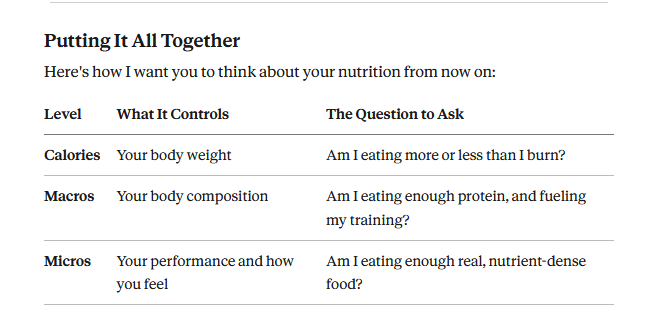
Notice the order. Start with calories, because without the right energy balance, nothing else moves the scale. Then dial in macros, so the weight you lose is fat, not muscle. Then make sure your micronutrients are covered, so you have the energy and recovery to keep showing up.
Skip a level and the whole thing wobbles:
Perfect macros with too many calories? Your weight won't drop.
Perfect calories with too little protein? You'll lose weight, but not the right kind.
Perfect calories and macros, but a diet of processed food and no vegetables? You may hit your numbers and still feel run down.
The Bottom Line
You don't have to count everything forever. But you do have to understand what each lever does.
Calories determine your body weight. Macronutrients determine your body composition. Micronutrients determine your performance.
Weight, composition, performance. Once you know which one you're trying to change, you know exactly where to focus.
If you want help figuring out where you stand, come in and let's get you scanned, set your baseline, and build a plan around your actual numbers, not guesses.
📍 New Level Fitness — 1000 E Union St. Morganton, NC 📞 828-334-3368 📸 @Newlevelfitnessllc